
Introduction: Why Airflow Issues Ruin Modern Hookah Performance
Modern hookahs are engineered for smooth, open draws and consistent smoke production. Yet many smokers experience restricted airflow, uneven pulls, or weak smoke, even when using high-quality tobacco and coals.
In most cases, the problem is not the tobacco—it is airflow imbalance caused by setup, components, or improper configuration.
This guide explains how airflow works in modern hookahs and provides practical, experience-backed solutions to restore smooth performance.
Understanding Airflow in Modern Hookah Design
Unlike traditional hookahs, modern hookahs use closed-chamber systems, precision-machined stems, and modular components. While these designs improve purge efficiency and flavor clarity, they are also more sensitive to small airflow disruptions.
Airflow in a modern hookah depends on:
-
Chamber type
-
Diffuser configuration
-
Purge valve performance
-
Hose adapters and hose material
-
Seal quality and grommet fit
Even one weak point can affect the entire system.
1. Diffuser Issues: The Most Common Airflow Restriction
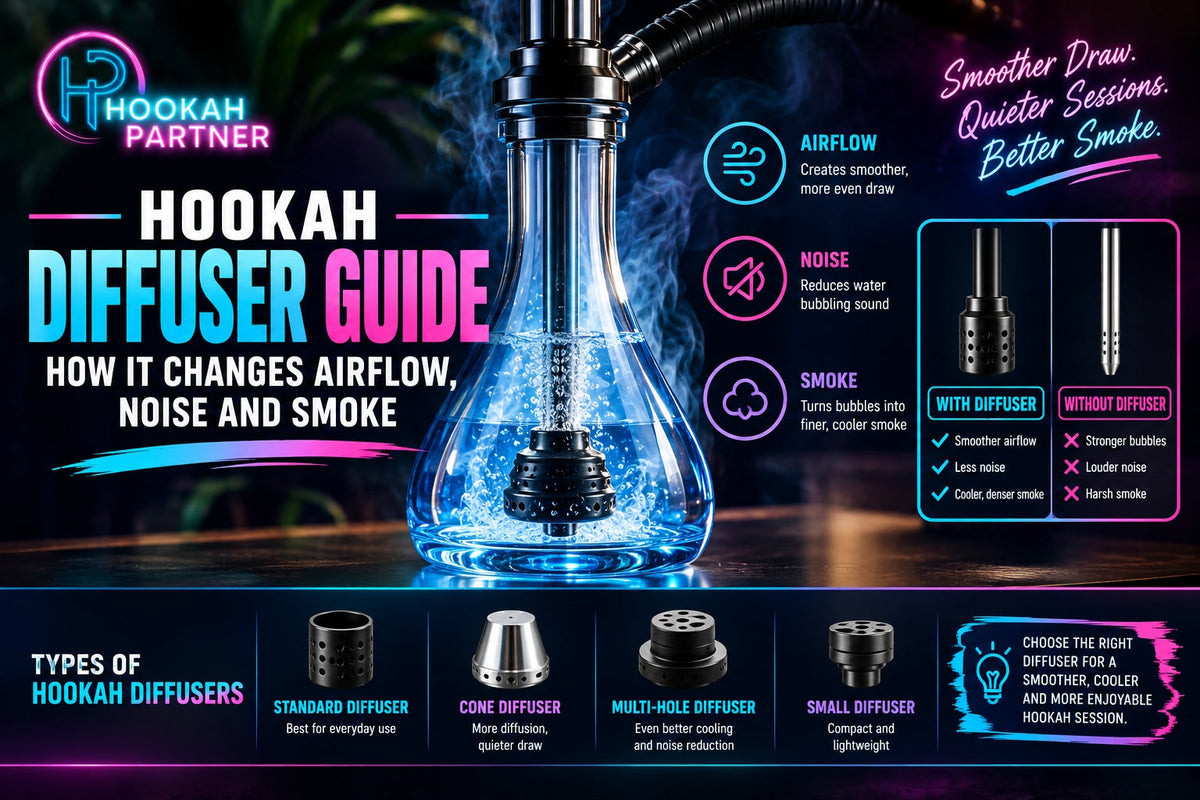
How Diffusers Affect Airflow
Diffusers break bubbles into smaller streams, reducing noise and softening the draw. However, poorly adjusted or overly restrictive diffusers can choke airflow.
Common Diffuser Problems
-
Diffuser holes are too small
-
Too many diffuser holes are blocked by water
-
Diffuser set too deep in the Base
-
Non-removable diffusers limit adjustment
How to Fix It
-
Adjust the diffuser height so it sits just below the waterline
-
Remove the diffuser temporarily to test draw resistance
-
Ensure diffuser holes are clean and unobstructed
-
Use adjustable or removable diffusers for flexibility
If airflow improves without the diffuser, the diffuser—not the hookah—is the issue.
2. Purge Valve Problems and Back Pressure
Why Purge Valves Matter
Modern hookahs rely on purge valves to clear stale smoke quickly. If purge valves are misaligned or dirty, they can create back pressure, restricting airflow during pulls.
Common Purge Valve Issues
-
Sticky ball bearings
-
Improper ball size
-
Residue buildup inside valve housing
-
Valves are not sealing fully
How to Fix It
-
Clean purge valves regularly with warm water
-
Ensure the ball moves freely without sticking
-
Use the manufacturer-recommended ball size
-
Replace worn valve components if purging feels inconsisten
A faulty purge valve often feels like a “soft block” during inhalation.
3. Hose Adapters and Hose Compatibility
Adapter Diameter Matters
Modern hookahs often include removable or modular hose adapters. If adapters have narrow internal diameters, airflow suffers regardless of hose quality.
Hose-Related Airflow Issues
-
Narrow internal hose diameter
-
Collapsed or kinked hoses
-
Flavor-absorbing materials restricting airflow
-
Poor adapter-to-hose fit
Best Practices
-
Use wide-bore hose adapters
-
Choose hoses with consistent internal diameter
-
Avoid overly stiff or bent hoses
-
Ensure airtight hose connections using proper grommets
Airflow should feel smooth, not turbulent or whistle-like.
4. Chamber Design: Closed vs Traditional Systems
Closed-Chamber Hookahs
Most modern hookahs use closed chambers, which allow faster purging but require precise sealing.
Airflow issues occur when:
-
Multiple hose ports are open without valves
-
Valve systems are improperly configured
-
Unused ports are not sealed
How to Optimize Chamber Performance
-
Seal unused hose ports properly
-
Check valve orientation
-
Avoid mixing incompatible valve systems
-
Test airflow with one hose before adding more
Modern chambers reward correct setup but punish shortcuts.
5. Grommets, Seals, and Micro Air Leaks
Why Small Leaks Cause Big Problems
Even tiny air leaks dilute smoke density and weaken pull strength.
Common leak points include:
-
Bowl grommet
-
Hose grommet
-
Base seal
-
Adapter joints
Fixing Seal Problems
-
Use correctly sized grommets, not stretched ones
-
Avoid forcing mismatched parts together
-
Replace hardened or cracked grommets
-
Test for leaks by blocking the bowl and pulling air
A properly sealed hookah should feel completely airtight.
6. Water Level and Downstem Submersion
How Water Level Impacts Airflow
Too much water increases resistance; too little reduces filtration.
Ideal downstem submersion:
-
Approximately 1 to 1.5 inches below the water surface
Too deep = restricted draw
Too shallow = weak filtration and unstable airflow
Adjust water level before replacing components.
7. Bowl and Heat Setup Side Effects
While airflow issues often originate below the tray, bowl setup can amplify the problem.
Potential issues include:
-
Overpacked bowls are restricting airflow
-
Foil holes are too small or blocked
-
Heat management devices sealing airflow unintentionally
Ensure:
-
Proper airflow through the bowl
-
Adequate space between tobacco and foil or HMD
-
Clean air channels in the bowl
Airflow must remain consistent from bowl to hose.
Troubleshooting Checklist
If airflow feels restricted, check in this order:
-
Remove diffuser and test the draw
-
Inspect purge valve movement
-
Test hose and adapter diameter
-
Seal unused hose ports
-
Check grommets and seals
-
Adjust water level
-
Review bowl airflow
Most airflow issues are solved before reaching step five.
Why Modern Hookahs Are More Sensitive to Airflow Issues
Modern hookahs are precision tools. Their advantages—clean flavor, smooth draw, fast purge—depend on balanced airflow.
When everything is aligned, performance is exceptional. When one element is off, problems appear quickly.
This sensitivity is not a flaw; it is a tradeoff for higher performance.
Conclusion: Smooth Airflow Is a System, Not a Single Part
Fixing airflow problems in modern hookahs requires understanding how diffusers, valves, adapters, chambers, and seals work together.
Instead of replacing the entire hookah, most issues can be resolved through:
-
Proper configuration
-
Regular maintenance
-
Component compatibility
-
Attention to sealing and airflow balance
At Hookah Partner, we focus on modern hookah systems designed for optimized airflow—so your setup performs exactly as engineered.